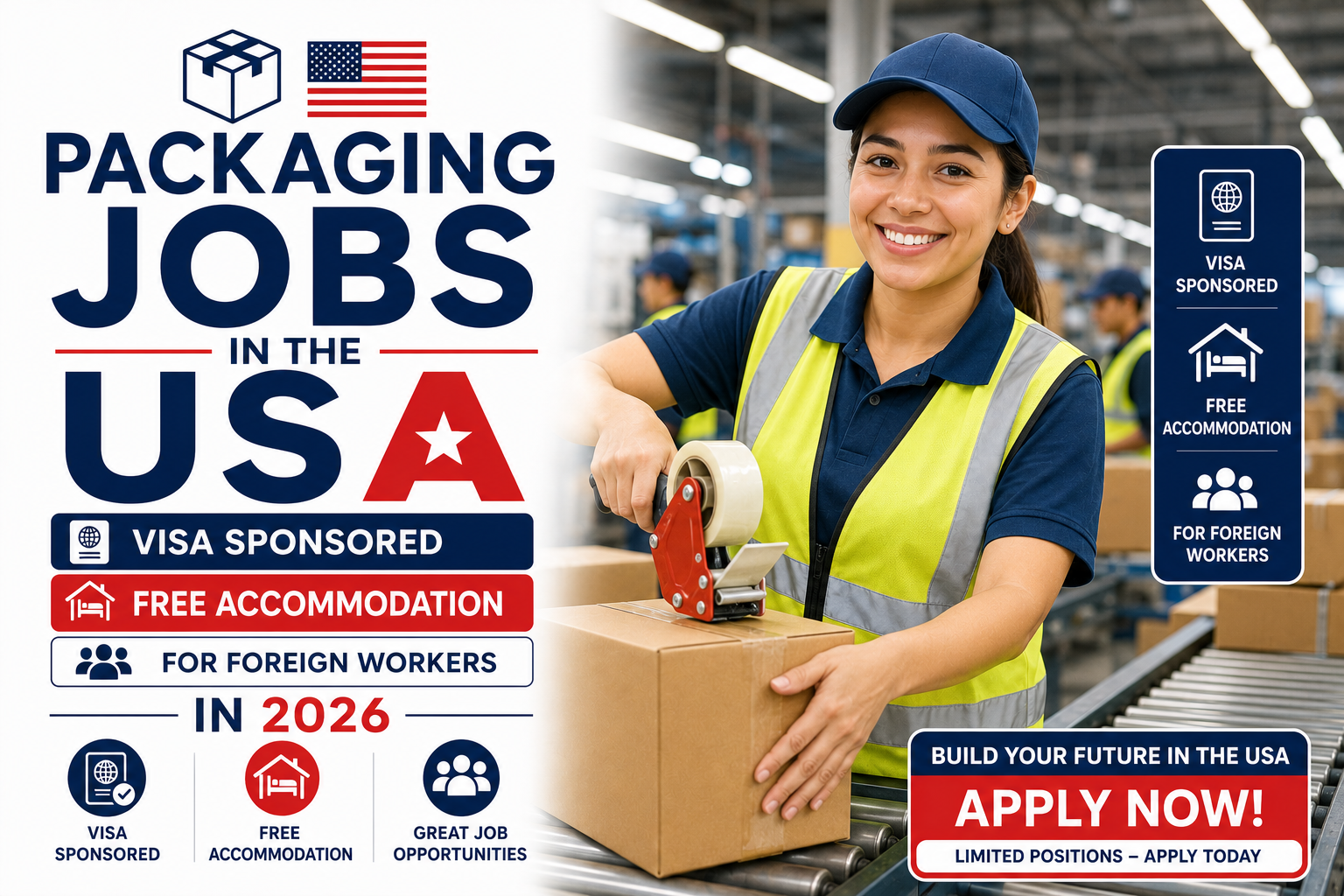
Packaging jobs in the United States may provide eligible foreign workers with an opportunity to earn an income while gaining international production, warehouse or food-handling experience.
American factories, warehouses, orchards, food-processing companies, seafood businesses and seasonal product distributors sometimes require additional workers during their busiest periods. When a qualifying employer cannot find enough available workers locally, it may apply to recruit foreign workers through an approved temporary employment programme.
Possible positions include hand packer, warehouse packer, food packer, fruit packer, seafood packer, order packer, production-line packer, labeller, sorter and packaging-machine assistant.
Some employers may also provide free shared accommodation, subsidised housing or transportation between employee housing and the worksite. However, accommodation is not included with every packaging job, and visa sponsorship is never automatic.
Applicants must find a genuine sponsoring employer, meet the stated job requirements and successfully complete the appropriate immigration process before travelling to the United States.
What Are Packaging Jobs with Visa Sponsorship?
Packaging jobs with visa sponsorship are temporary positions for which a qualifying American employer files an immigration petition on behalf of selected foreign workers.
There is no official immigration category called a “packaging visa.”
Depending on the employer and type of work, a temporary packaging position may fall under either:
| Visa route | Type of packaging work |
|---|---|
| H-2A | Temporary or seasonal agricultural packing, such as packing fruit, vegetables or crops connected to an agricultural operation |
| H-2B | Temporary non-agricultural packing, such as factory packaging, warehouse packing, seafood processing, product packaging or off-farm packing |
The H-2A programme covers qualifying temporary agricultural employment, while the H-2B programme covers qualifying temporary non-agricultural work. Under both programmes, the American employer or authorised agent must begin the process and file the required petition for the prospective worker.
A foreign worker cannot independently sponsor themselves for an H-2A or H-2B packaging job.
Why Do American Employers Recruit Temporary Packaging Workers?
Businesses may need additional packers when production, harvesting or customer orders increase temporarily.
This can happen during:
- Fruit and vegetable harvest seasons
- Seafood-processing seasons
- Christmas and holiday production
- Seasonal retail demand
- Large temporary manufacturing contracts
- Tourism seasons
- Increased warehouse orders
- Food-production periods
- Agricultural packing seasons
- Peak shipping periods
For example, a company selling holiday ornaments advertised an active 2026 temporary packing position for 12 workers from October 1 to December 12, 2026. The employees would locate products, check orders, pack boxes, prepare shipping labels and restock warehouse shelves. The position paid $20.48 per hour for 40 hours weekly and required no previous experience.
A Pennsylvania orchard also advertised 28 active fruit-packing positions beginning in August 2026. Workers would grade apples, operate bagging and labelling equipment, prepare cartons, stack boxes and clean packing machinery.
Recruitment status can change quickly. Applicants should always confirm that a job order remains active before applying.
Types of Packaging Jobs That May Offer Visa Sponsorship
1. Hand Packer
Hand packers place products into boxes, cartons, bags, trays or other containers.
Their duties may include:
- Inspecting products
- Counting items
- Weighing materials
- Placing products into containers
- Sealing cartons
- Applying labels
- Folding boxes
- Removing defective products
- Stacking finished cartons
- Moving packages to pallets
- Cleaning the work area
A 2026 Louisiana confectionery job order requested 65 hand packers to package chocolate sweets. Workers placed sweets into trays, assembled boxes, shrink-wrapped products, labelled cartons and stacked finished boxes on pallets. The job paid $14.49 per hour for 40 hours weekly and required no previous experience or formal education. That particular recruitment order is now inactive.
2. Warehouse Packer
Warehouse packers prepare customer orders for shipping or collection.
Typical duties include:
- Locating products
- Reading order information
- Picking items from shelves
- Checking product numbers
- Confirming quantities
- Wrapping fragile goods
- Packing cartons
- Sealing boxes
- Printing shipping labels
- Restocking shelves
- Loading outgoing orders
Warehouse packers may use handheld scanners, warehouse-management systems or computerised shipping equipment.
The active Nebraska packing job cited earlier involved packaging holiday ornaments, checking order accuracy, creating shipping labels and assisting with loading and unloading trucks.
3. Food Packer
Food packers prepare processed or prepared food products for storage, sale or transportation.
Responsibilities may include:
- Checking food quality
- Measuring portions
- Filling packages
- Sealing containers
- Labelling products
- Checking expiry information
- Packing cartons
- Removing damaged products
- Cleaning equipment
- Following hygiene requirements
Workers may be required to wear:
- Hairnets
- Beard covers
- Gloves
- Aprons
- Safety footwear
- Protective clothing
Food-packing employees must normally follow strict sanitation and personal-hygiene rules.
4. Fruit Packer
Fruit packers inspect, grade and package apples, oranges, berries, peaches and other fresh produce.
Their duties may include:
- Sorting fruit by size
- Checking colour and quality
- Removing damaged fruit
- Operating bagging equipment
- Placing fruit into cartons
- Applying labels
- Sealing boxes
- Stacking cartons
- Cleaning machinery
- Following food-safety procedures
The active Pennsylvania apple-packing order offered $17.99 per hour for 40 hours weekly. Applicants needed three months of verifiable packaging or warehouse experience involving fruit grading and had to be capable of lifting boxes weighing up to 50 pounds.
Agricultural fruit-packing positions may fall under H-2A rather than H-2B, depending on the relationship between the packing duties and the agricultural operation.
5. Vegetable Packer
Vegetable packers sort and prepare vegetables for sale or processing.
Possible duties include:
- Removing damaged vegetables
- Sorting products by size
- Washing produce
- Filling bags
- Weighing packages
- Closing cartons
- Applying labels
- Stacking boxes
- Cleaning packing areas
An active 2026 New York job order requested 54 bean packers. Workers would sort, pack and stack beans and were required to lift up to 60 pounds. The position paid $16 per hour and required two months of agricultural experience.
6. Seafood Packer
Seafood packers prepare fish, lobster, crab, shrimp or shellfish for freezing, storage or shipment.
Their duties may include:
- Sorting seafood
- Weighing products
- Packing seafood into containers
- Adding ice
- Sealing packages
- Labelling cartons
- Moving products into freezers
- Cleaning equipment
- Sanitising packing areas
The work may involve cold temperatures, wet floors, strong odours and repetitive movements.
Applicants with serious seafood allergies should carefully consider whether this type of work is safe for them.
7. Candy or Confectionery Packer
Confectionery packers prepare sweets, chocolates and other products for retail distribution.
They may:
- Place sweets into trays
- Check that packages contain the correct number of products
- Fold display boxes
- Operate shrink-wrapping equipment
- Apply stickers
- Inspect products
- Remove damaged items
- Stack finished cartons
The Louisiana chocolate-packing job cited earlier used 10-hour shifts and required manual dexterity, prolonged standing and the ability to lift up to 50 pounds.
8. Factory Packer
Factory packers package manufactured products such as:
- Furniture components
- Building materials
- Decorations
- Clothing
- Cleaning products
- Household goods
- Industrial supplies
- Consumer products
Their duties may include:
- Inspecting containers
- Wrapping products
- Assembling crates
- Measuring items
- Filling containers
- Sealing packages
- Marking cartons
- Moving completed products
- Removing defective items
A 2026 Idaho natural-stone packing order requested 80 workers and offered $15.52 per hour for 40 hours weekly. No previous experience was required, and optional shared housing was available at no charge. The position is now inactive.
9. Floral Product Packer
Floral packaging workers may prepare flowers, wreaths, arrangements and decorative products for shipping.
Duties may include:
- Preparing packaging materials
- Passing materials to floral designers
- Checking product appearance
- Wrapping arrangements
- Placing products into boxes
- Securing decorations
- Labelling packages
- Maintaining clean work areas
Workers may need excellent manual dexterity and the ability to stand throughout an eight-hour shift.
One previous seasonal floral-packing order did not provide employer housing but offered to help workers locate accommodation at their own expense.
10. Production-Line Packer
Production-line packers work beside conveyor systems.
They may:
- Place products into containers
- Check product flow
- Remove damaged goods
- Close lids
- Apply labels
- Pack completed items into larger cartons
- Stack cartons
- Clean production equipment
- Maintain production speed
The work can be fast and repetitive. Employees may have to perform the same movement hundreds of times during a shift.
11. Packaging-Machine Assistant
Packaging-machine assistants help operate equipment that fills, seals, labels or wraps products.
Duties may include:
- Loading packaging materials
- Monitoring equipment
- Removing finished packages
- Clearing approved minor blockages
- Checking labels
- Reporting faults
- Cleaning machinery
- Assisting machine operators
Applicants should not claim machinery experience they do not possess.
12. Labelling Worker
Labelling workers attach product, shipping, safety or identification labels.
They may:
- Print labels
- Check product codes
- Apply labels by hand
- Load labels into machines
- Confirm addresses
- Check barcodes
- Remove incorrectly labelled products
- Record batch information
Accuracy is particularly important when labels contain health, safety or delivery information.
13. Sorter and Grader
Sorters inspect products and separate them according to:
- Size
- Colour
- Shape
- Weight
- Quality
- Condition
- Intended use
Agricultural sorters may separate fruit or vegetables, while factory sorters may inspect manufactured products.
14. Order Picker and Packer
Order pickers locate goods within a warehouse and package them for customers.
Their duties may include:
- Reading order lists
- Using scanners
- Locating products
- Confirming quantities
- Packing boxes
- Printing labels
- Preparing orders for dispatch
- Updating inventory information
Basic reading, numeracy and computer skills may be required.
15. Shipping Packer
Shipping packers prepare goods for transport.
They may:
- Select suitable containers
- Wrap fragile products
- Add protective materials
- Seal cartons
- Apply shipping labels
- Weigh packages
- Confirm delivery information
- Move packages to loading areas
Workers must follow instructions carefully to prevent damaged or misdirected shipments.
Recent Packaging Job Examples
The following examples are based on official 2026 job records:
| Position | Advertised wage | Weekly hours | Experience | Housing |
|---|---|---|---|---|
| Holiday-product packer | $20.48 per hour | 40 hours | None required | Not stated in the public summary |
| Apple packer | $17.99 per hour | 40 hours | Three months | H-2A terms may apply |
| Chocolate hand packer | $14.49 per hour | 40 hours | None required | Check full job order |
| Natural-stone packer | $15.52 per hour | 40 hours | None required | Free optional shared housing |
| Off-farm agricultural packer | Wage stated in job order | 35 hours | None required | Free optional housing and daily transport |
| Bean packer | $16 per hour | 57 hours | Two months | Agricultural housing rules may apply |
Some of these jobs were active when checked on July 25, 2026, while others were inactive and are included only to demonstrate wages and employment conditions previously advertised.
Applicants must verify current recruitment status before applying.
How Much Can Packaging Workers Earn?
Total earnings depend on:
- Hourly wage
- Guaranteed weekly hours
- Contract length
- Overtime availability
- Shift premiums
- Production bonuses
- Housing deductions
- Taxes
- Other lawful deductions
Possible gross earnings may look like this:
| Hourly wage | Weekly hours | Contract length | Estimated gross earnings |
|---|---|---|---|
| $14.49 | 40 hours | 28 weeks | $16,228.80 |
| $15.52 | 40 hours | 30 weeks | $18,624 |
| $17.99 | 40 hours | 20 weeks | $14,392 |
| $18.50 | 40 hours | 30 weeks | $22,200 |
| $20.48 | 40 hours | 10 weeks | $8,192 |
| $20.50 | 40 hours | 32 weeks | $26,240 |
| $22.00 | 40 hours | 35 weeks | $30,800 |
These calculations are examples rather than guaranteed salary offers.
A higher hourly wage does not always produce higher total earnings. A short holiday-packing contract may pay more per hour but generate less total income than a lower-paid position lasting several months.
Can Packaging Workers Earn More Than $26,000?
A packaging worker may earn more than $26,000 when the position offers:
- A comparatively high hourly wage
- A long employment contract
- At least 40 weekly hours
- Regular overtime
- Shift premiums
- Performance bonuses
For example:
- $20.50 per hour × 40 hours × 32 weeks = $26,240
- $19 per hour × 40 hours × 35 weeks = $26,600
- $22 per hour × 40 hours × 30 weeks = $26,400
These are gross-income illustrations.
Taxes, housing charges and other lawful deductions will reduce take-home pay.
Is Overtime Guaranteed?
No.
An employer may offer extra hours when production or orders increase, but this does not mean that overtime is guaranteed.
Packing schedules can be affected by:
- Customer demand
- Crop availability
- Weather
- Raw-material supply
- Factory breakdowns
- Seafood or harvest availability
- Shipping delays
- Production targets
Workers should calculate expected earnings using the guaranteed hours stated in the job order.
Do Packaging Jobs Require a University Degree?
Many entry-level packaging positions do not require a university degree.
Official 2026 orders for chocolate packers, holiday-product packers and natural-stone packers stated that no previous experience was required.
Employers may focus more on:
- Manual dexterity
- Physical ability
- Reliability
- Attention to detail
- Availability for the entire contract
- Ability to stand for long periods
- Ability to follow instructions
- Ability to meet production standards
- Willingness to work shifts
Some specialised fruit-grading, machinery or warehouse positions require previous experience.
Can Applicants Apply Without Experience?
Some employers recruit workers without previous experience and provide training.
Possible entry-level positions include:
- Hand packer
- Warehouse packer
- Production-line packer
- General packaging helper
- Product sorter
- Labelling worker
- Basic order packer
Other employers may require:
- One month of packaging experience
- Three months of warehouse experience
- Fruit-grading experience
- Food-production experience
- Machine-operation experience
- Experience using scanners
- Experience reading customer orders
- Commercial packing experience
The Pennsylvania apple-packing position required three months of packaging or warehouse experience involving fruit grading. In contrast, the Nebraska holiday-product packing position required no previous experience.
Applicants should not claim experience they cannot verify.
Physical Requirements of Packaging Work
Packaging work can be physically demanding.
Workers may need to:
- Stand for eight to twelve hours
- Perform repetitive movements
- Bend repeatedly
- Lift heavy cartons
- Push loaded carts
- Stack boxes
- Work near conveyor systems
- Work in hot or cold environments
- Work in refrigerated rooms
- Wear protective equipment
- Work early or overnight shifts
- Maintain a required production speed
Official job orders commonly require workers to lift between 40 and 60 pounds. The active apple-packing position required workers to lift and stack boxes weighing up to 50 pounds, while the active bean-packing order required lifting up to 60 pounds.
Applicants should honestly assess whether they can safely perform the required duties.
Typical Packaging Work Schedules
Packaging businesses may operate:
- Day shifts
- Evening shifts
- Overnight shifts
- Ten-hour shifts
- Weekend shifts
- Public-holiday shifts
- Rotating schedules
The Louisiana confectionery packing order used four 10-hour shifts, with one shift running from 5 a.m. to 3 p.m. and another running from 4 p.m. to 2 a.m.
The precise schedule may change according to production requirements.
Applicants should confirm:
- The regular start time
- The regular finishing time
- Whether shifts rotate
- Whether weekend work is compulsory
- Whether overtime is available
- Whether transport operates during late shifts
Do Packaging Employers Provide Accommodation?
Some employers provide accommodation, but housing is not automatically included with every packaging job.
Possible arrangements include:
Free Shared Accommodation
The employer provides shared housing without charging ordinary rent.
The Idaho natural-stone packing order offered optional shared accommodation at no cost.
An off-farm packing employer in Georgia also offered optional free housing and daily transport between the housing and worksite.
Subsidised Housing
The employer may pay part of the accommodation cost while the worker pays the remaining amount.
Paid Employee Housing
The employer arranges housing but deducts a weekly or monthly charge from the worker’s wages.
Employer-Assisted Housing
The employer helps workers locate accommodation but does not pay the rent.
No Housing Provided
The worker must independently find and pay for accommodation.
A seafood-packing employer in Oregon specifically stated that it did not provide housing or transportation between workers’ residences and the worksite.
Important Difference Between H-2A and H-2B Housing
Accommodation rules differ between H-2A and H-2B employment.
Under the H-2A programme, an employer must generally provide safe housing at no cost when workers cannot reasonably return to their permanent residence within the same day. The employer must also provide free daily transportation between the accommodation and worksite.
Under the H-2B programme, employers are not generally required to provide free housing for the entire contract. Some H-2B employers voluntarily provide free or subsidised accommodation, while others provide no housing.
Applicants should determine which visa category applies to the position before assuming that accommodation must be free.
Questions to Ask About Accommodation
Before accepting an offer, ask:
- Does the employer provide housing?
- Is the housing free?
- Is it available throughout the contract?
- How much is the weekly rent?
- Are electricity and water included?
- Is internet included?
- Is a security deposit required?
- Is the deposit refundable?
- How many workers share each room?
- Are beds and furniture provided?
- Are cooking facilities available?
- Is daily transportation provided?
- Does transport operate for night shifts?
- Can family members stay there?
- Will rent be deducted from wages?
- When must workers leave after the contract?
Request the accommodation terms in writing.
How Housing Costs Affect Take-Home Earnings
Consider a packaging worker earning $17.99 per hour for 40 hours per week.
Weekly gross earnings would be:
$17.99 × 40 hours = $719.60
Possible amounts remaining before taxes could include:
| Weekly housing cost | Gross amount after housing |
|---|---|
| Free housing | $719.60 |
| $75 | $644.60 |
| $100 | $619.60 |
| $125 | $594.60 |
| $150 | $569.60 |
| $200 | $519.60 |
Workers may also need to pay for:
- Taxes
- Meals
- Telephone service
- Personal items
- Local transportation
- Work clothing
- Medical expenses
- Housing deposits
- Utilities not included in rent
Calculate expected savings using the complete job offer rather than the hourly wage alone.
Who May Qualify for a Sponsored Packaging Job?
Requirements vary between employers, but applicants may need to:
- Hold a valid international passport
- Meet the employer’s experience requirements
- Be available for the entire contract
- Perform repetitive duties
- Stand for long periods
- Lift the stated weight
- Follow food or workplace safety procedures
- Work rotating shifts
- Work weekends when required
- Pass a lawful employer-paid drug test where applicable
- Pass a lawful background check where required
- Provide genuine employment documents
- Qualify for the relevant H-2A or H-2B visa
- Intend to leave after temporary employment ends
Some employers require workers to be at least 18 because of insurance, workplace or safety rules.
Documents Applicants May Need
Applicants should prepare clear copies of:
- Valid international passport
- Current CV or résumé
- Passport photograph
- Employment reference letters
- Packaging or warehouse certificates
- Food-safety certificates
- Machine-operation certificates
- Educational records
- Driver’s licence where required
- Police records where requested
- Medical records where requested
- Written employment offer
- Official job-order details
- Approved petition receipt information
- DS-160 confirmation page
- Visa-fee receipt where applicable
Documents not written in English may require certified translations.
How to Prepare a Packaging Job CV
A strong packaging CV should focus on relevant practical experience.
Include Relevant Employment
List previous work in:
- Factories
- Warehouses
- Supermarkets
- Food-processing companies
- Fruit-packing facilities
- Seafood-processing plants
- Manufacturing companies
- Distribution centres
- Retail stockrooms
- Agricultural packing operations
Include Packaging Skills
Useful skills may include:
- Product inspection
- Sorting
- Grading
- Weighing
- Packing
- Labelling
- Carton assembly
- Shrink-wrapping
- Pallet stacking
- Order picking
- Barcode scanning
- Quality control
- Conveyor-line work
- Worksite cleaning
Include Safety Experience
Mention genuine experience with:
- Protective equipment
- Safe lifting
- Food sanitation
- Machine guards
- Chemical labels
- Emergency procedures
- Cold-room safety
- Incident reporting
Include Physical Abilities
Applicants may state that they can:
- Stand for extended periods
- Lift the required weight
- Perform repetitive hand movements
- Work in cold or hot conditions
- Work rotating shifts
- Work weekends
Only include abilities you genuinely possess.
Provide Verifiable References
A former employer should be able to confirm:
- Your job title
- Employment dates
- Main duties
- Reliability
- Packaging or warehouse experience
How to Find Genuine Packaging Sponsorship Jobs
The U.S. Department of Labor’s SeasonalJobs database publishes temporary job orders associated with H-2A and H-2B labour-certification processes.
Useful search terms include:
- Packer
- Hand packer
- Packers and packagers
- Warehouse packer
- Food packer
- Fruit packer
- Vegetable packer
- Seafood packer
- Production packer
- Packaging worker
- Order packer
- Shipping packer
- Sorter
- Grader
- Labelling worker
The database contains active and inactive records.
Applicants must confirm the status of a job before applying.
How to Read an Official Job Order
Do not apply based only on the job title or hourly wage.
Check:
- Employer’s legal name
- Worksite address
- Job title
- Visa or programme classification
- Number of workers requested
- Hourly wage
- Weekly hours
- Overtime conditions
- Contract start date
- Contract end date
- Experience requirements
- Lifting requirements
- Production standards
- Shift times
- Housing arrangements
- Transportation conditions
- Application instructions
- Job-order case number
- Current recruitment status
A listing marked “inactive” should not be treated as a current vacancy.
Step-by-Step Application Process
Step 1: Find a Suitable Position
Search for packaging jobs matching your experience, physical ability and availability.
Step 2: Identify the Correct Visa Route
Determine whether the position is:
- Temporary agricultural work under H-2A
- Temporary non-agricultural work under H-2B
Do not assume every fruit-packing or food-packing position uses the same visa.
Step 3: Confirm That Recruitment Is Open
Check the job order’s status, employment dates and application instructions.
Old job records may remain visible online after recruitment has ended.
Step 4: Verify the Employer
Confirm:
- Legal company name
- Official website
- Physical address
- Telephone number
- Professional email address
- Department of Labor job order
Use independently verified contact information whenever possible.
Step 5: Follow the Official Application Instructions
The employer may request applications through:
- Telephone
- Company careers page
- State workforce agency
- Postal application
- Official recruitment portal
Follow the stated method exactly.
Step 6: Submit a Relevant CV
Tailor your CV to the job.
A fruit-packing application should emphasise grading and produce-handling experience, while a warehouse-packing application should emphasise picking, order accuracy, labelling and shipping.
Step 7: Attend the Employer’s Interview
Possible interview questions may cover:
- Previous packaging experience
- Warehouse experience
- Physical ability
- Availability
- Shift flexibility
- Safety knowledge
- Food-handling experience
- Ability to meet production targets
- Housing requirements
- English communication
An interview does not guarantee selection or visa sponsorship.
Step 8: Receive a Written Employment Offer
A genuine offer should explain:
- Employer’s legal identity
- Job title
- Worksite
- Hourly wage
- Weekly hours
- Contract dates
- Overtime conditions
- Shift schedule
- Housing terms
- Transportation arrangements
- Expected deductions
- Relevant visa category
Step 9: Employer Completes the Petition Process
The qualifying employer must obtain the appropriate temporary labour certification and file the required petition with USCIS.
USCIS states that the prospective employer or authorised agent must file Form I-129 on the worker’s behalf for H-2A or H-2B classification.
The worker cannot independently file the employer’s sponsorship petition.
Step 10: Complete the Visa Application
After USCIS approves the employer’s petition, the selected worker may need to:
- Complete Form DS-160
- Upload a suitable photograph
- Pay the applicable visa fee
- Schedule an interview
- Provide petition information
- Present supporting documents
Most temporary-worker visa applicants must have an approved employer petition before applying for the visa. A consular officer separately determines whether the individual qualifies.
Step 11: Attend the Visa Interview
Applicants should answer all questions truthfully.
The consular officer may ask about:
- The employer
- Packaging duties
- Previous experience
- Contract dates
- Worksite
- Housing arrangements
- Travel plans
- Intention to leave after temporary employment
An approved petition does not guarantee visa issuance.
Step 12: Travel Only After Visa Approval
Do not purchase a non-refundable ticket merely because an employer or recruiter says that sponsorship has been approved.
Before travelling, confirm:
- The visa has been issued
- The employer expects your arrival
- The position remains available
- Housing arrangements are clear
- Transportation instructions are available
- You have the correct worksite address
- You have copies of the job order and employment offer
H-2B Visa Availability in 2026
The regular H-2B statutory cap is 66,000 visas per United States financial year.
For financial year 2026, the United States government made up to 64,716 additional H-2B visas available on top of the regular allocation. These additional visas were divided into specific allocations and were subject to employer eligibility requirements and numerical limits.
The availability of additional visas does not guarantee that every applicant will receive:
- A packaging job
- Sponsorship
- Petition approval
- A visa
- Free accommodation
- Free transportation
H-2A employment is governed by a different programme and is not included in the annual H-2B cap.
Visa and Transportation Expenses
H-2B employers must generally provide or reimburse qualifying visa, visa-processing and related fees.
Workers may also be entitled to reasonable inbound transportation and subsistence reimbursement after completing 50% of the job-order period. Return transportation may be required after the contract is completed or when the worker is dismissed before the end of the authorised employment period.
H-2A workers have related protections covering transportation, meals and free housing when they cannot reasonably return to their permanent homes each day.
Travel reimbursement should not be confused with free long-term housing under an H-2B contract.
Rights of H-2B Packaging Workers
H-2B workers should receive accurate written information about their wages, hours, working conditions and benefits.
Applicable protections generally include:
- Payment at the wage stated in the job order
- Payment at least every two weeks
- Written information about deductions
- An itemised pay statement
- Required tools and equipment without charge
- Qualifying visa-fee reimbursement
- Qualifying transportation reimbursement
- Protection against prohibited recruitment charges
- Protection against retaliation
- Protection against employers keeping workers’ passports
- The applicable three-fourths employment guarantee
Employers and their agents must not request or receive prohibited recruitment or certification payments from workers.
Rights of H-2A Packaging Workers
H-2A workers must generally receive:
- A copy of the employment contract
- Payment at least twice monthly
- An itemised pay statement
- The wage stated in the contract
- The applicable three-fourths guarantee
- Free qualifying housing
- Free daily transport between housing and work
- Required tools and equipment without charge
- Workers’ compensation coverage
- Qualifying inbound and return transportation
- Protection against prohibited recruitment fees
These protections apply when the packaging position qualifies as temporary agricultural work under the H-2A programme.
What Is the Three-Fourths Guarantee?
Under the applicable H-2A and H-2B rules, employers generally must offer employment or payment for at least three-fourths of the hours promised during the relevant contract period or calculation period.
For H-2B job orders, the guarantee generally applies over 12-week periods, or six-week periods when the job order lasts less than 120 days.
The three-fourths guarantee does not mean that overtime is guaranteed.
Can Packaging Workers Bring Their Families?
The spouse and unmarried children under 21 of an H-2A or H-2B worker may generally apply for H-4 dependent status.
However, H-4 dependants generally cannot work in the United States solely because they are accompanying an H-2A or H-2B worker.
Employer accommodation may also be restricted to recruited employees.
Before travelling with family members, consider:
- Additional visa fees
- Flight costs
- Private accommodation
- Food
- Health insurance
- Schooling
- Local transportation
- Whether family members are permitted in employer housing
- Whether temporary earnings can support the household
Do not assume that the employer will pay the relocation expenses of accompanying family members.
Can a Packaging Job Lead to Permanent Residency?
An H-2A or H-2B packaging job does not automatically provide permanent residency.
Both visa routes are intended for temporary employment.
An employer could separately decide to sponsor a qualified employee for a genuine permanent position through another immigration category. This would involve a separate process and additional requirements.
Applicants should not accept a temporary packaging job based only on a recruiter’s verbal promise that a green card will be provided later.
Common Packaging Job Scams
Foreign applicants should be cautious when someone:
- Guarantees a packaging job
- Guarantees visa approval
- Demands payment for a job slot
- Claims that no employer petition is required
- Offers employment without an application or interview
- Refuses to identify the employer
- Uses only a social-media account
- Requests cryptocurrency
- Demands payment into a personal bank account
- Promises completely free relocation
- Offers an unrealistic wage
- Claims to control the embassy
- Asks applicants to submit false documents
- Refuses to provide a written job order
- Pressures applicants to pay immediately
- Requests bank passwords
- Asks to keep the worker’s passport
USCIS rules prohibit the collection of certain fees connected with H-2A and H-2B employment, and Department of Labor rules prohibit employers and recruiters from charging workers prohibited recruitment and certification fees.
No employer, agent or lawyer can guarantee the final decision of USCIS or a consular officer.
How to Verify a Packaging Job Offer
Before accepting an offer:
- Search the employer’s full legal name.
- Check the official company website.
- Verify the physical address.
- Find the Department of Labor job order.
- Confirm whether it is an H-2A or H-2B position.
- Check that the listing is active.
- Compare the wage and contract dates.
- Confirm the housing arrangement.
- Contact the employer directly.
- Request written information about deductions.
- Ask for petition information at the appropriate stage.
- Do not pay prohibited recruitment fees.
- Do not surrender your passport.
A professional-looking offer letter, company logo or social-media page does not prove that an opportunity is genuine.
How to Improve Your Chances of Being Selected
Gain Relevant Experience
Experience in packaging, warehousing, retail stocking, food production, agricultural packing or manufacturing may strengthen your application.
Learn Packaging Safety
Useful knowledge includes:
- Safe lifting
- Conveyor safety
- Machine guards
- Food hygiene
- Product labelling
- Emergency exits
- Protective-equipment use
- Cold-room safety
- Incident reporting
Prepare Employment References
Ask previous employers to confirm:
- Your job title
- Employment dates
- Main duties
- Reliability
- Packaging experience
Improve Your English
Packaging workers may need to understand:
- Safety warnings
- Product labels
- Order numbers
- Measurements
- Supervisor instructions
- Emergency procedures
- Production targets
Apply Early
Temporary employers may begin recruitment several months before the intended employment date.
Tailor Your CV
Adjust your résumé to match each job order.
Be Honest About Your Abilities
Do not claim fruit-grading, forklift, machine-operation or food-production experience you do not possess.
Advantages of Sponsored Packaging Employment
A genuine sponsored position may provide:
- Legal temporary employment
- Regular hourly wages
- Clearly stated contract dates
- Possible overtime
- Possible free or subsidised accommodation
- International packaging experience
- Employer-provided tools and protective equipment
- Qualifying transportation reimbursement
- Qualifying visa-fee reimbursement
- Protection under applicable labour rules
- Professional references
Benefits vary between employers and visa programmes.
Challenges Applicants Should Consider
Packaging work may involve:
- Repetitive movements
- Long periods of standing
- Heavy lifting
- Fast production targets
- Cold or hot environments
- Early-morning shifts
- Overnight work
- Weekend work
- Shared accommodation
- Limited privacy
- Housing deductions
- Variable overtime
- Seasonal employment
- Temporary immigration status
Applicants should read the entire job order before accepting employment.
Frequently Asked Questions
Are packaging jobs available to foreign workers?
Yes. Qualifying American employers may recruit eligible foreign workers for approved temporary packaging positions through the H-2A or H-2B programme.
Which visa is used for packaging jobs?
Agricultural packing may qualify under H-2A, while temporary non-agricultural packaging may qualify under H-2B. The classification depends on the employer and nature of the work.
Do packaging jobs require a university degree?
Many entry-level packaging jobs do not require a degree. Some positions require previous warehouse, grading or machinery experience.
Can I apply without packaging experience?
Some employers accept workers without experience and provide training. Other positions require verifiable experience.
Is accommodation always provided?
No. H-2B housing may be free, subsidised, paid or unavailable. Qualifying H-2A workers who cannot return home daily are generally entitled to free employer-provided housing.
Can I apply directly for an H-2A or H-2B visa?
No. A qualifying American employer or authorised agent must first complete the labour-certification and petition process.
Does an approved employer petition guarantee a visa?
No. A consular officer separately determines whether the individual qualifies for the visa.
Can an agent charge me for packaging sponsorship?
Employers and their recruiters must not charge workers prohibited recruitment, certification or job-placement fees.
Are sponsored packaging jobs permanent?
H-2A and H-2B packaging jobs are temporary.
Can I work for another packaging company after arriving?
A temporary worker cannot simply begin working for an unauthorised employer. The new employer must complete the appropriate immigration process before the worker is permitted to work there.
Is overtime guaranteed?
No. Overtime may be available, but workers should not rely on it unless it is guaranteed in writing.
Will the employer pay for my flight?
The employer may be required to provide or reimburse qualifying inbound and return transportation. The rules and timing differ between H-2A and H-2B employment.
Can my spouse and children travel with me?
Eligible spouses and unmarried children under 21 may generally apply for H-4 status, but employer housing may not permit family members.
Final Thoughts
Packaging jobs in the USA with visa sponsorship and accommodation can provide eligible foreign workers with an opportunity to gain legal temporary employment experience.
Possible positions include hand packer, warehouse packer, fruit packer, vegetable packer, seafood packer, factory packer, order packer, production-line packer and labelling worker.
Some packaging positions fall under the H-2A agricultural programme, while others fall under the H-2B non-agricultural programme. This distinction affects the sponsorship process, visa availability and accommodation rules.
Some employers provide free shared housing and daily transportation, while others offer paid accommodation or no housing assistance.
Before accepting an offer, applicants should confirm:
- The correct visa category
- Hourly wage
- Guaranteed weekly hours
- Contract dates
- Overtime conditions
- Physical requirements
- Housing arrangements
- Transportation terms
- Expected deductions
- Official application method
The sponsorship process must begin with a genuine qualifying American employer. A worker cannot purchase sponsorship or independently file the employer’s petition.
Applicants should use official job records, verify every employer and avoid anyone demanding payment for a guaranteed packaging job, visa or immigration approval.
Notice: This article provides general educational information. It is not a packaging job offer, visa guarantee or legal advice. Job availability, wages, visa allocations and immigration procedures can change. Applicants should verify current information through USCIS, the U.S. Department of Labor and the appropriate U.S. embassy or consulate before making payments or travel arrangements.